
Working hours in building services
Building services CLA and Swiss labour law – what plumbing, heating, ventilation and sheet-metal businesses need to know
A generally binding collective labour agreement applies to the building services industry. It governs annual hours, two overtime accounts, bonuses and travel time – and requires traceable working-time records. Here are the key points.
At a glance
40 h
Normal weekly hours
2,088 h
Annual working hours 2026 (incl. public holidays, excl. weekends)
25%
Bonus on overtime above 45 hours per week
25 days
Holidays from age 21 to 49 – more for younger and older staff
Who does the CLA apply to?
The CLA for the Swiss building services industry has been declared generally binding. It applies to all executing businesses in the industry – such as plumbing, heating, ventilation, air conditioning and sheet-metal work – even without membership in the suissetec association. Pure planning firms are not covered.
The cantons of Geneva, Vaud and Valais have their own rules.
Working hours
- Normal working time is 40 hours per week.
- Annual working time in 2026 is 2,088 hours – counted over all weekdays including public holidays, excluding Saturdays and Sundays.
- The statutory maximum under the Labour Act must always be respected.
Overtime: two accounts
The CLA distinguishes two kinds of overtime, kept separately:
- Account A – hours between 40 and 45 per week: generally compensated with time off of equal length within the same calendar year, without a bonus.
- Account B – hours above 45 per week: earn a 25% bonus in time or money and are settled at year-end, or every six months at the employee's request.
Because both accounts are calculated week by week, a simple monthly balance is not enough – you need records per day and week.
Bonuses for evening, night and Sunday work
- Sunday and public-holiday work: 100% bonus
- Evening work from 8 pm to 11 pm: 25% bonus if more than 8 hours were worked that day
- Temporary night work from 11 pm to 6 am: 50% bonus (for fewer than 25 nights per calendar year)
Travel time
- The journey between home and the contractual place of employment is not paid working time.
- Trips from the place of employment to the site and between sites count as paid working time.
Mandatory time records
The CLA requires businesses to record their employees' working hours. Businesses without time records risk a contractual penalty when inspected by the joint commission. If the records are traceable but do not meet every requirement, the penalty may be reduced.
Holidays
- Up to age 20: 27 days
- Age 21 to 49: 25 days
- Age 50 to 54: 27 days
- Age 55 to 60: 28 days
- Age 61 to 65: 30 days
What the Labour Act adds
- Daily and weekly working hours including overtime, and breaks of 30 minutes or more, must be recorded (Art. 46 ArG, Art. 73 ArGV 1).
- Records must be kept for at least 5 years.
- Night and Sunday work generally requires official authorisation.
Minimum wages and 13th month's salary
Minimum wages by category and the 13th month's salary are set in the CLA. You will find the current rates at suissetec and the joint commission (links below).
How Pontora helps
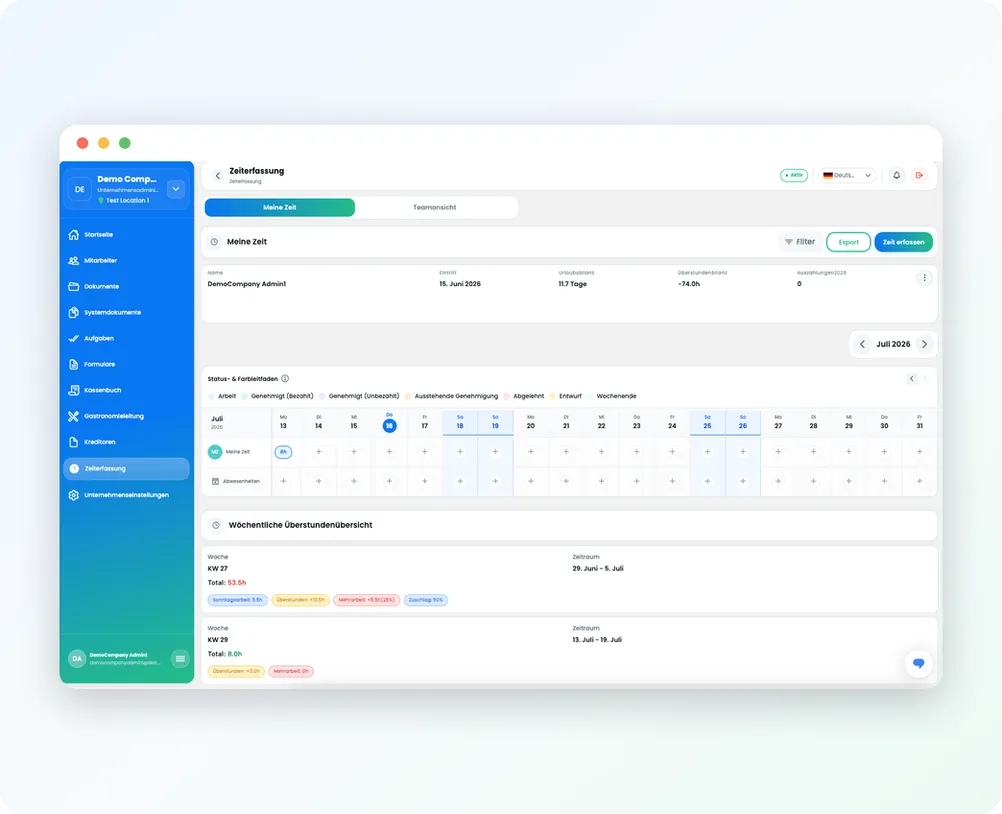
Pontora's time tracking turns these rules into everyday routine – from clocking in on site to settling overtime at year-end.
- Track hours right on site Employees clock in from their phone – even across several sites per day.
- Bonuses built in Set weekly limits and 25%, 50% and 100% bonuses once – Pontora does the maths.
- Balances and records ready Overtime, holidays and payouts at a glance – for employees, your trustee and inspections.
Click to enlarge
Frequently asked questions
What are the working hours in building services?
Normal working time is 40 hours per week. In 2026, that adds up to 2,088 annual hours.
When is an overtime bonus due?
For hours above 45 per week (account B): 25% in time or money. Hours between 40 and 45 per week (account A) are compensated with time off, without a bonus.
Does the trip to the site count as working time?
Trips from the place of employment to the site and between sites do. The journey from home to the place of employment does not.
Does the CLA apply to planning firms?
No. The CLA applies to executing building services businesses, not to pure planning firms.
Agreements & legal texts
- CLA for the Swiss building services industry – overview (German) ↗ gav-service.ch
- suissetec – collective labour agreement (German) ↗ suissetec.ch
- Joint commission for building services – CLA (German) ↗ plk-gebaeudetechnik.ch
- Labour Act (ArG) ↗ SR 822.11
- Ordinance 1 to the Labour Act (ArGV 1) ↗ SR 822.111
As of October 2026. This overview is general information and does not replace legal advice. The binding text is the CLA in force, including its supplementary agreements and annexes.