
Working hours in the painting and plastering trade
CLA 2026–2029 and Swiss labour law – what your business needs to know
A new collective labour agreement (GAV) has applied to the painting and plastering trade since 1 April 2026. It governs annual working hours, overtime, Saturday work and travel time – and requires complete working-time records. Here are the key points at a glance.
At a glance
2,088 h
Annual working hours 2026 and 2027 (2028: 2,080 h)
40 h
Average weekly hours, 8 h per day
48 h
Maximum weekly hours at 80% workload or more
25%
Time bonus for hours beyond the weekly maximum
Who does the CLA apply to?
The Federal Council has declared the CLA for the painting and plastering trade generally binding – from 1 April 2026 to 31 March 2029. It therefore applies to all businesses within its scope, including those that are not members of the trade association.
It covers large parts of German-speaking Switzerland and Ticino. French-speaking Switzerland and some regions have their own agreements. The CLA defines in detail whether your business is covered.
Working hours: an annual total instead of a fixed week
The CLA uses annual working hours. This lets you spread work across the year – more hours in peak season, fewer in quiet months – as long as the maximum limits are respected.
- Annual working hours 2026 and 2027: 2,088 hours (261 days × 8 hours); 2028: 2,080 hours
- On average 40 hours per week or 8 hours per day
- Maximum at 80–100% workload: 48 hours per week
- Maximum below 80% workload: 9.6 hours per day
Overtime and bonuses
- Overtime ordered by the employer, and its bonuses, are generally compensated with time off.
- Hours beyond the weekly maximum are credited with a 25% time bonus.
- Night, Sunday and public-holiday work earns a 100% time bonus. Under the Labour Act it generally also requires official authorisation.
- Overtime not compensated with time off is paid out with a bonus – deadlines and caps are set by the CLA.
Saturday work
Saturday work is generally paid with a 25% wage bonus. Depending on company size, a set number of Saturdays per year may be worked without the bonus. These must be reported digitally to the responsible regional joint commission (RPBK) in advance – by Friday, 3 pm.
Travel time
Travel time to the site must be recorded separately in the working-time records. For member companies of the painters' and plasterers' employer association, part of it remains unpaid; this share decreases step by step:
- 2026/2027: 25 minutes per day unpaid
- 2027/2028: 20 minutes per day unpaid
- 2028/2029: 15 minutes per day unpaid
Important: this travel-time rule has not been declared generally binding. Businesses that are not association members pay the full travel time.
Mandatory working-time records
The CLA requires accurate working-time records based on hourly work reports – using the template of the central joint commission (ZPBK) or an equivalent system. The joint commissions check compliance; without traceable records, contractual penalties may apply.
- Record working time and travel time separately
- Employees may inspect their records at any time
- At year-end or when leaving, employees receive their working-time records
What the Labour Act adds
The Swiss Labour Act applies alongside the CLA. Where the CLA is stricter – such as the 48-hour maximum instead of 50 hours – the CLA takes precedence.
- Daily and weekly working hours including overtime, and breaks of 30 minutes or more, must be recorded (Art. 46 ArG, Art. 73 ArGV 1).
- Records must be kept for at least 5 years.
- A rest period of at least 11 hours applies between two working days.
Holidays, wages and 13th month's salary
Holiday entitlement, minimum wages by wage class and the 13th month's salary are also set in the CLA. You will find the current rates in the CLA and its annexes (links below).
How Pontora helps
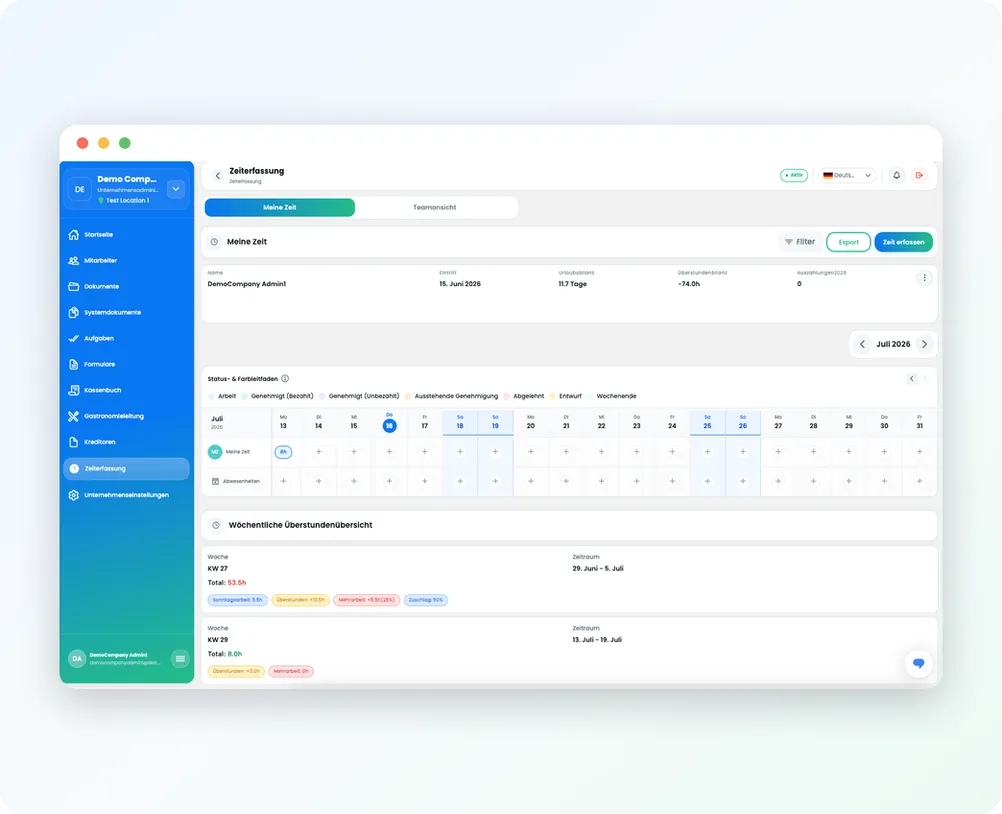
Pontora's time tracking turns these rules into everyday routine – from clocking in on site to the year-end balance.
- Track hours right on site Employees clock in from their phone – no paper reports to collect every Friday.
- Your CLA rules built in Set weekly hours, limits and 25% / 100% bonuses once – Pontora does the maths.
- Balances and records ready Overtime, holidays and payouts at a glance – for employees, your trustee and inspections.
Click to enlarge
Frequently asked questions
Does the CLA also apply to businesses that are not association members?
Yes. The CLA is generally binding from 1 April 2026 to 31 March 2029 and applies to all businesses within its scope. The exception is the travel-time rule: it only applies to association members; everyone else pays the full travel time.
What are the annual working hours in 2026?
2,088 hours (261 days × 8 hours). The same applies in 2027; in 2028 it is 2,080 hours.
Do I have to record travel time?
Yes. Travel time must be recorded separately from working time.
How long must I keep working-time records?
Under the Labour Act, at least 5 years (Art. 73 ArGV 1).
Agreements & legal texts
- CLA for the painting and plastering trade (full text & annexes, German) ↗ gav-service.ch
- Central joint commission (ZPBK) ↗ Enforcement, time records, notifications
- Swiss painters' and plasterers' association (SMGV) ↗ smgv.ch
- Labour Act (ArG) ↗ SR 822.11
- Ordinance 1 to the Labour Act (ArGV 1) ↗ SR 822.111
As of October 2026. This overview is general information and does not replace legal advice. The binding text is the CLA in force, including its supplementary agreements and annexes.