
Working hours in the construction industry
National framework agreement (LMV) 2026–2031 and Swiss labour law – what your construction business needs to know
Since 2026, a new national framework agreement (LMV) has applied to the main construction trade, running until the end of 2031. It changes working-time planning, overtime and travel time. Here are the key rules at a glance.
At a glance
2,112 h
Annual working hours – 40.5 hours per week on average
37.5–45 h
Weekly hours under the working-time calendar
50 h
Beyond this: excess hours (work + travel) with a 25% bonus
2031
The new LMV runs until the end of 2031
Who does the LMV apply to?
The Federal Council has declared the LMV 2026–2031 generally binding (from 1 April 2026 to 31 December 2031). It therefore applies to all employers whose main activity is in the main construction trade – such as building, civil engineering or road construction – even without membership in the builders' association.
There are no annual wage negotiations during its term – unless extraordinary inflation exceeds 2%.
Annual working hours and working-time calendar
Working time is planned across the year. Annual working time is 2,112 hours, equivalent to an average week of 40.5 hours. The business sets the distribution in a working-time calendar.
- Weekly hours in the calendar: at least 37.5 and at most 45 hours
- With a regular four- or four-and-a-half-day week, the minimum can drop to 32 hours
- Up to five zero-hour days per year can be planned in the calendar
- From 2027, a balanced model with constant daily hours is available as an alternative
2026 is a transition year: the planning year used to run from May to April. A separate working-time calendar is needed for May to December 2026; from 2027, planning follows the calendar year.
Overtime and excess hours
- Overtime is time beyond the planned weekly hours in the calendar. It is kept in an overtime account – from 2027 within a range of −20 to +120 hours.
- At year-end, the worker decides on at least half of their overtime: payout, carry-over to the new year or a long-term holiday account.
- Excess hours: work and travel time that together exceed 50 hours per week are paid in the following month at the base wage plus a 25% bonus.
- The former bonus for hours between 48 and 50 per week no longer applies.
Travel time
Travel time to the site is kept separate from annual working hours, but must be recorded.
- In 2026, the first 30 minutes of travel per day are unpaid and covered by a flat site allowance.
- From 2027, travel time above 60 minutes per day (above 90 minutes with constant daily hours) goes straight into the overtime account.
- In 2030 and 2031, the flat-rate travel time is reduced step by step to 20 minutes.
Mandatory time records
The LMV requires employers to keep detailed records of daily, weekly and monthly working time. Because the overtime account, excess hours and travel time are tracked separately, accurate daily records are the basis for every correct payroll.
What the Labour Act adds
- Daily and weekly working hours including overtime, and breaks of 30 minutes or more, must be recorded (Art. 46 ArG, Art. 73 ArGV 1).
- Records must be kept for at least 5 years.
- A rest period of at least 11 hours applies between two working days.
Holidays, wages and allowances
Holiday entitlement, minimum wages by wage class, the 13th month's salary and allowances are also set in the LMV. You will find the current rates in the contract text (links below).
How Pontora helps
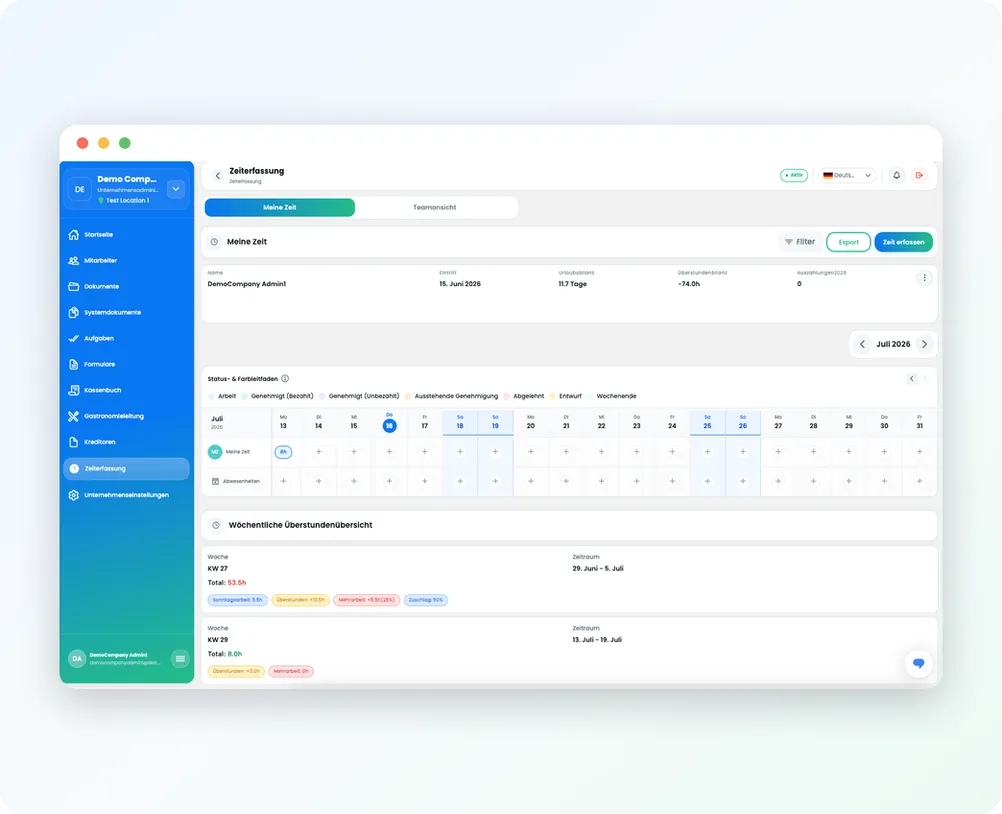
Pontora's time tracking turns these rules into everyday routine – from clocking in on site to the overtime balance at year-end.
- Track hours right on site Employees clock in from their phone – no timesheets to type up.
- Your working-time model built in Set weekly hours, limits and bonuses once – Pontora calculates overtime and bonuses.
- Balances and records ready Overtime, holidays and payouts at a glance – for employees, your trustee and inspections.
Click to enlarge
Frequently asked questions
What are the annual working hours in construction?
2,112 hours per year, 40.5 hours per week on average. The business sets the distribution in its working-time calendar – between 37.5 and 45 hours per week.
When is a 25% bonus due?
When work and travel time together exceed 50 hours per week (excess hours). These hours are paid in the following month at the base wage plus 25%.
Does travel time count as working time?
Travel time is kept separate from annual working hours. In 2026 the first 30 minutes per day are unpaid and covered by a site allowance; from 2027, travel time above 60 minutes per day goes straight into the overtime account.
What happens to the working-time calendar in 2026?
2026 is a transition year: the previous calendar applies until the end of April, and a separate calendar is needed for May to December 2026. From 2027, planning follows the calendar year.
Agreements & legal texts
- National framework agreement for construction (LMV) – overview & full text (German) ↗ gav-service.ch
- LMV 2026–2031 (PDF, German) ↗ SVK Bauhauptgewerbe
- Swiss builders' association – social partnership ↗ baumeister.swiss
- Labour Act (ArG) ↗ SR 822.11
- Ordinance 1 to the Labour Act (ArGV 1) ↗ SR 822.111
As of October 2026. This overview is general information and does not replace legal advice. The binding text is the CLA in force, including its supplementary agreements and annexes.