
Working hours in the office
Labour Act and Code of Obligations – what applies to offices and SMEs without a CLA
Most offices are not covered by a collective labour agreement. The rules come from the Labour Act, the Swiss Code of Obligations (OR) and the employment contract. Here you will learn how long employees may work, how overtime differs from excess hours and when simplified time recording is allowed.
At a glance
45 h
Maximum weekly hours for office staff
25%
Overtime bonus under the OR – can be changed in writing
60 h
Excess hours per year without a mandatory bonus for office staff
5 years
Retention period for working-time records
Who is this overview for?
Offices, administrations, trustee and consulting firms, agencies and any other business not covered by a collective labour agreement. There, working time is governed by the Labour Act (public law), the OR and the employment contract.
Senior executives with far-reaching decision-making powers are exempt from the Labour Act. Only the OR and their employment contract apply to them.
Maximum hours and breaks
- Office staff, technical employees and sales staff in large retail businesses have a maximum working week of 45 hours (Art. 9 ArG).
- Contractual hours are usually lower, often 40 to 42 hours.
- Breaks: at least 15 minutes for more than 5½ hours, 30 minutes for more than 7 hours and one hour for more than 9 hours of work per day (Art. 15 ArG).
- A rest period of at least 11 hours applies between two working days.
Overtime and excess hours – the difference
Overtime is time worked beyond the contractual hours – up to the legal maximum of 45 hours. It is governed by the OR (Art. 321c):
- With the employee's consent, overtime can be compensated with time off of equal length.
- Otherwise it must be paid at the normal wage plus a bonus of at least 25%.
- The bonus and compensation can be arranged differently in writing, for example in the employment contract. A verbal agreement is not enough.
Excess hours are hours worked beyond the 45-hour maximum. They are limited to 2 hours per day and 170 hours per year. The 25% bonus is mandatory and cannot be waived – for office staff, however, only for excess hours above 60 per calendar year (Art. 12 and 13 ArG).
Mandatory time recording
Full time recording is the rule in offices too (Art. 46 ArG, Art. 73 ArGV 1):
- Daily and weekly working hours including compensatory and excess hours, and when they were worked
- Breaks of 30 minutes or more
- Records kept for at least 5 years
Simplified time recording
Employees who can set a substantial part of their working hours themselves may record their time in a simplified way (Art. 73b ArGV 1). Then the total hours worked per day are enough – breaks and the timing of work need not be recorded.
- As a rule, this requires an agreement with the employee representatives or, where there are none, with the majority of employees.
- In businesses with fewer than 50 employees, simplified recording can also be agreed individually in writing.
- For night and Sunday work, the start and end of each shift must still be recorded.
Waiving time recording entirely (Art. 73a ArGV 1) is only possible under a collective labour agreement – and only for employees with high autonomy and a gross annual salary above CHF 120,000. For most SMEs without a CLA, this is not an option.
Trust-based working time is not an exemption
Trust-based working time means employees organise their own hours. It does not exempt them from the legal duty to record time: anyone covered by the Labour Act must record their hours – at least in simplified form.
Holidays and public holidays
Under the OR, employees are entitled to at least 4 weeks of holidays per year, and 5 weeks up to age 20. 1 August is a paid public holiday throughout Switzerland; other public holidays are set by the cantons.
How Pontora helps
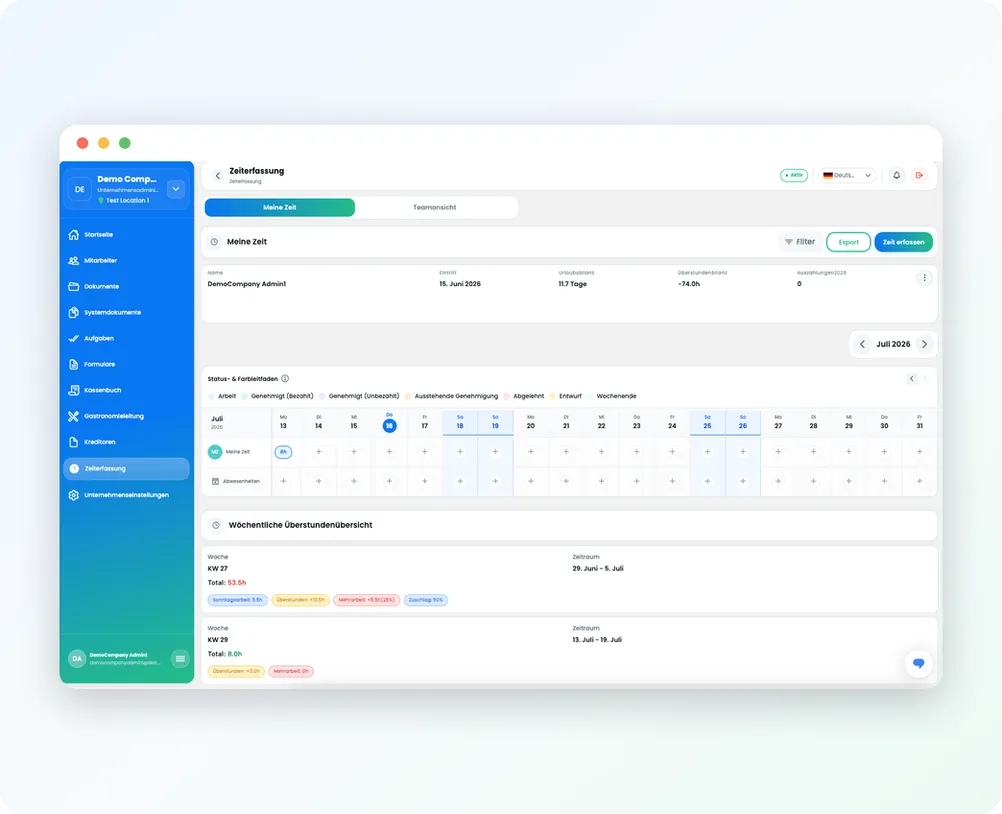
With Pontora, employees record their hours in seconds – in the office, working from home or on the road. Pontora calculates overtime, holidays and balances automatically.
- Clock in by phone or computer No Excel, no timesheets – recording takes just a few seconds.
- Your rules built in Set target hours, limits and bonuses once – Pontora calculates overtime and excess hours.
- Records ready at any time Balances and reports for employees, your trustee and any labour inspection.
Click to enlarge
Frequently asked questions
Is time recording mandatory in an office?
Yes. Anyone covered by the Labour Act must record their working time – in offices and with trust-based working time too. Under certain conditions, simplified recording of the total daily hours is enough.
What is the difference between overtime and excess hours?
Overtime is above the contractual hours but below the legal maximum of 45 hours. Excess hours are above those 45 hours. Overtime is governed by the OR, excess hours by the Labour Act.
Can the overtime bonus be excluded in the employment contract?
For overtime, yes, if agreed in writing. For excess hours, no: the 25% bonus is mandatory – for office staff from the 61st excess hour in a calendar year.
When is simplified time recording allowed?
For employees who can set a substantial part of their working hours themselves. It is agreed with the employee representatives or the majority of employees, and in businesses with fewer than 50 employees also individually in writing.
Agreements & legal texts
- SECO – time recording (German) ↗ seco.admin.ch
- SECO – FAQ on overtime (German) ↗ seco.admin.ch
- Labour Act (ArG) ↗ SR 822.11
- Ordinance 1 to the Labour Act (ArGV 1) ↗ SR 822.111
As of October 2026. This overview is general information and does not replace legal advice. The binding text is the CLA in force, including its supplementary agreements and annexes.