
Working hours in the electrical industry
Electrical industry CLA 2026–2029 and Swiss labour law – what electrical installation businesses need to know
A new collective labour agreement has applied to the electrical and telecommunications installation industry since 1 January 2026. It changes overtime, commuting and holidays – and requires time records accurate to the minute. Here are the key rules.
At a glance
40 h
Normal weekly hours
2,088 h
Gross annual working hours 2026
100 h
Overtime that may be carried over to the next year
27–30 days
Holidays per year – 30 days from age 50
Who does the CLA apply to?
The CLA for the Swiss electrical industry is generally binding from 1 January 2026 to 31 December 2029. It applies to electrical and telecommunications installation businesses and their employees throughout Switzerland – even without membership in the EIT.swiss association.
Exceptions apply in the canton of Geneva and partly in Valais, where cantonal agreements are in force.
Working hours
- Normal weekly hours are 40, plus any agreed pre-worked time.
- Gross annual working time is what counts: 2,088 hours in 2026.
- The employer organises daily and weekly hours, which may differ by team or project.
Overtime
- Overtime only arises once gross annual working time is exceeded.
- Overtime is only compensated if the employer or their deputy ordered it or approved it afterwards.
- Up to 100 overtime hours may be carried over to the following year; they must be reduced within a year by agreement.
- Overtime above these 100 hours is paid out with a 25% bonus.
New in the CLA 2026–2029: the former overtime "pots" 1 and 2 were abolished, and the threshold for the bonus dropped from 120 to 100 hours.
Commuting
The new CLA changes the rules on commuting: part of the travel time counts as paid working time, and expenses are reimbursed for work away from base. The exact conditions are set out in the CLA (link below).
Mandatory precise time recording
The CLA requires precise recording: the start of work, breaks and the end of work must be recorded accurately in the morning, at midday and in the evening. Failing to record time this way is a breach of the CLA and is sanctioned by the joint commission. Time reports are among the documents that must be available during an inspection.
A simple daily total is not enough in the electrical industry – start, breaks and end must each be visible.
Holidays
- Up to age 49: 27 days of holidays per year
- From age 50: 30 days of holidays per year
What the Labour Act adds
- Daily and weekly working hours including overtime, and breaks of 30 minutes or more, must be recorded (Art. 46 ArG, Art. 73 ArGV 1).
- Records must be kept for at least 5 years.
- A rest period of at least 11 hours applies between two working days.
Minimum wages
The CLA sets minimum wages by category; they rise in steps during its term. You will find the current rates in the CLA and at the joint commission (links below).
How Pontora helps
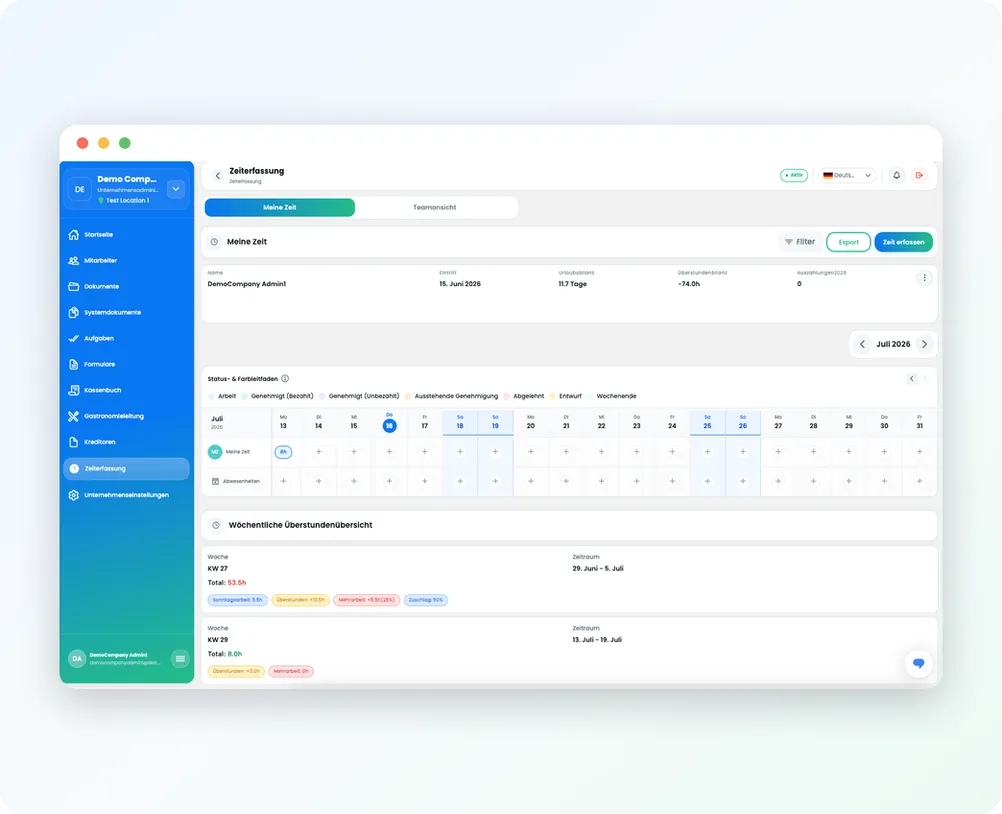
With Pontora's time tracking, your employees record start, breaks and end precisely – exactly as the CLA requires.
- Start, breaks and end by phone Employees clock in right at the customer's – every break is cleanly documented.
- Annual hours at a glance Set target hours and bonuses – Pontora shows where each person stands against annual working time.
- Ready for inspection Balances and reports available at any time – for employees, your trustee and the joint commission.
Click to enlarge
Frequently asked questions
How many hours do people work in the electrical industry?
Normal weekly hours are 40. Gross annual working time is what counts – 2,088 hours in 2026.
How much overtime may be carried over to the next year?
Up to 100 hours. They must be reduced within a year by agreement. Anything above is paid out with a 25% bonus.
Is it enough to note the hours per day?
No. The CLA requires the start of work, breaks and end of work to be recorded precisely. Otherwise it is a breach of the CLA.
How many holidays does the new CLA provide?
27 days up to age 49 and 30 days from age 50.
Agreements & legal texts
- CLA for the Swiss electrical industry – overview (German) ↗ gav-service.ch
- EIT.swiss – new CLA 2026–2029 (German) ↗ eit.swiss
- Electrical industry CLA 2026–2029 (PDF, German) ↗ eit.swiss
- Joint commission for the electrical industry (German) ↗ plk-elektro.ch
- Labour Act (ArG) ↗ SR 822.11
- Ordinance 1 to the Labour Act (ArGV 1) ↗ SR 822.111
As of October 2026. This overview is general information and does not replace legal advice. The binding text is the CLA in force, including its supplementary agreements and annexes.