
Working hours in the cleaning industry
CLA for the cleaning industry in German-speaking Switzerland 2026–2029 – what your cleaning business needs to know
A new collective labour agreement has applied to the cleaning industry in German-speaking Switzerland since 1 January 2026. Many employees work part-time, are paid by the hour and work at changing sites – which makes accurate time records all the more important. Here are the key rules.
At a glance
42 h
Maximum weekly hours at 100% workload
30 April
Deadline to compensate the previous year's overtime with time off
25%
Bonus on uncompensated hours above 42 h per week
4–5 weeks
Holidays per year, depending on age and years of service
Who does the CLA apply to?
The CLA for the cleaning industry in German-speaking Switzerland 2026–2029 has been declared generally binding by the Federal Council and has applied since 1 January 2026. It therefore covers all cleaning businesses within its scope – even without membership in the industry association Allpura.
For small businesses with 1 to 5 employees, only some provisions are generally binding. French-speaking Switzerland has its own CLA.
Weekly working hours
Weekly hours are set in the individual employment contract. For a 100% workload, they may not exceed 42 hours per week.
Overtime and bonuses
- Overtime should be compensated with time off by 30 April of the following year.
- Uncompensated overtime within the 42-hour weekly maximum is then paid out without a bonus.
- Uncompensated hours above the weekly maximum are paid out with a 25% bonus.
- For night and Sunday work, a wage bonus on the minimum wage applies under the CLA in addition to the statutory time bonus; night and Sunday bonuses are not cumulative.
Mandatory time records
The employer must keep time records for all employees and inform them of their current balance. Employees may inspect their records at any time.
With part-time work, hourly pay and several sites per day, this is almost impossible on paper: without running balances, you can neither meet the 30 April deadline nor calculate the bonus correctly.
Holidays and hourly pay
- Up to age 20: 5 weeks of holidays
- From age 21: 4 weeks of holidays
- From age 50 with at least 5 years of service: 5 weeks of holidays
- Hourly-paid employees receive a holiday supplement: 8.33% for 4 weeks or 10.64% for 5 weeks of holidays
Minimum wages
The CLA sets minimum wages by activity, such as maintenance and specialist cleaning. They were raised on 1 January 2026. Some cantons and cities also have statutory minimum wages that may be higher – the higher amount always applies. You will find the current rates in the CLA (links below).
What the Labour Act adds
- Daily and weekly working hours including overtime, and breaks of 30 minutes or more, must be recorded (Art. 46 ArG, Art. 73 ArGV 1).
- Records must be kept for at least 5 years.
- Night and Sunday work generally requires official authorisation.
How Pontora helps
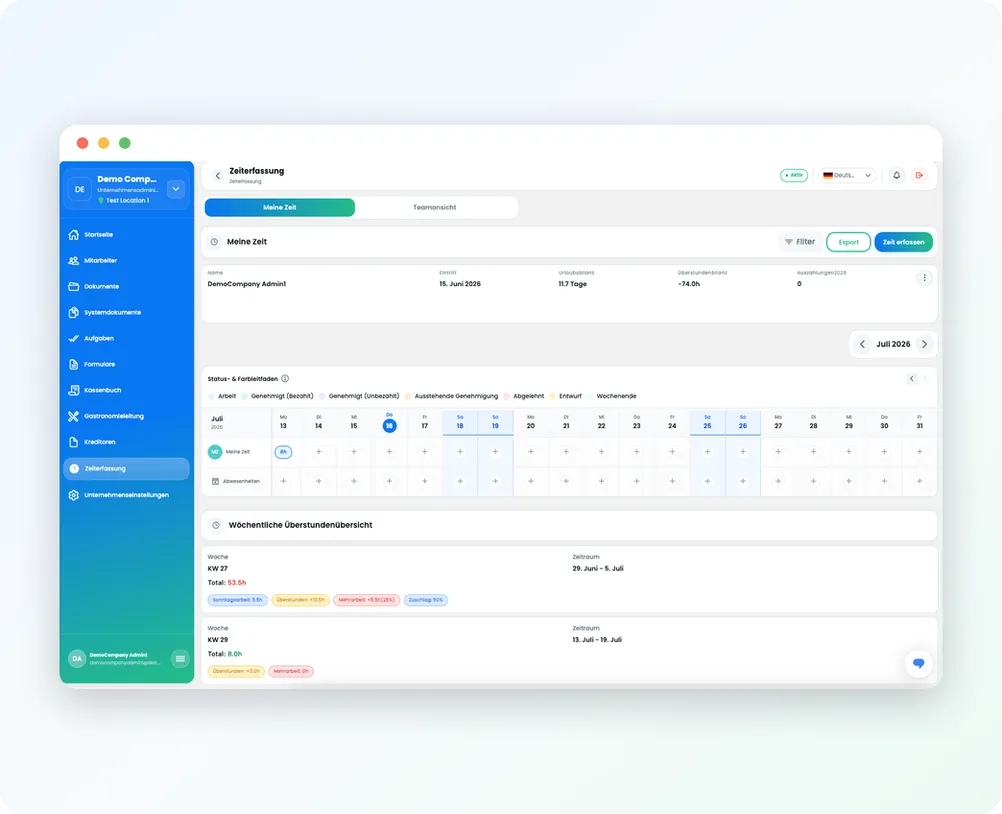
With Pontora, your employees record their hours right at the site – and you keep track of overtime, holidays and deadlines for everyone.
- Recording on site Employees clock in by phone at the site – even with several jobs per day.
- Part-time and hourly pay under control Set workloads, target hours and bonuses per person – Pontora keeps balances up to date.
- Balances visible at any time Employees see their own balances – exactly as the CLA requires.
Click to enlarge
Frequently asked questions
How many hours per week may employees work in cleaning?
Weekly hours are set in the employment contract. For a 100% workload, the CLA caps them at 42 hours per week.
By when must overtime be compensated?
By 30 April of the following year. After that, uncompensated hours are paid out – without a bonus within 42 hours per week, with a 25% bonus above that.
Does the CLA apply to small cleaning companies too?
Yes, but for businesses with 1 to 5 employees only some provisions are generally binding. Which ones is set out in the Federal Council decree on the CLA.
Must employees be able to see their time balance?
Yes. The employer must inform them of the status of their time records, and they may inspect them at any time.
Agreements & legal texts
- CLA cleaning industry German-speaking Switzerland – overview (German) ↗ gav-service.ch
- CLA 2026–2029 (PDF, German) ↗ Allpura
- Central joint commission for cleaning – CLA contents (German) ↗ zpk-reinigung.ch
- Labour Act (ArG) ↗ SR 822.11
- Ordinance 1 to the Labour Act (ArGV 1) ↗ SR 822.111
As of October 2026. This overview is general information and does not replace legal advice. The binding text is the CLA in force, including its supplementary agreements and annexes.